In today’s advanced optical systems, reflection control is about far more than reducing glare, it is about improving performance, accuracy and reliability.
While standard anti-reflective (AR) coatings are widely used to minimise reflections in the visible spectrum, applications involving near-infrared (NIR) light require a more specialised solution.
This is where NIR anti-reflective coating offer a significant advantage.
What Is an NIR AR Coating?
An NIR anti-reflective coating is a specialist optical coating designed to reduce reflections in the near-infrared wavelength range, typically between 700nm and 2500nm.
Unlike standard AR coatings, which are optimised for visible light wavelengths of approximately 400–700nm, NIR AR coatings are engineered to deliver maximum light transmission and minimum reflectance in the infrared range.
This makes them essential for systems that rely on infrared sensors, imaging or measurement technologies.
Why Standard AR Coatings Are Not Always Suitable
A standard AR coating performs exceptionally well in applications where the primary focus is visible light transmission, such as:
- display windows
- touchscreens
- instrument panels
- protective covers
- optical viewing panels
However, when a system relies on NIR wavelengths, a standard AR coating may not perform effectively.
This can lead to:
- reduced infrared light transmission
- increased reflectance
- poor sensor performance
- reduced image clarity
- lower measurement accuracy
For customers working with infrared-based technologies, this can directly affect the end performance of the product.
Key Benefits of NIR AR Coatings
Improved NIR Light Transmission
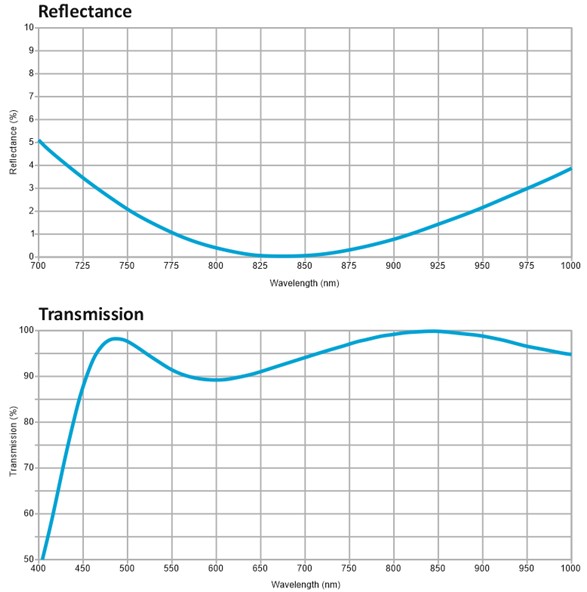
The primary reason customers choose an NIR AR coating is to maximise transmission in the near-infrared spectrum.
By reducing surface reflections at the required wavelength, more infrared light is able to pass through the substrate and reach the sensor or detector.
This improves overall system efficiency and sensitivity.
Enhanced Sensor Accuracy
Many sensing technologies depend on precise infrared light detection.
Surface reflections can create:
- stray light
- ghost images
- signal interference
- poor signal-to-noise ratio
An NIR AR coating helps minimise these issues, leading to clearer signals and more accurate readings.
Better Performance in Low-Light and Infrared Imaging
Applications such as night vision, surveillance systems and machine vision cameras often operate using NIR illumination. Reducing reflection in this wavelength range improves:
- image sharpness
- contrast
- detection reliability
- object recognition performance
Customised Wavelength Performance
One of the key advantages of NIR coatings is that they can be tailored to specific wavelength bands. This allows customers to specify a coating that precisely matches their application requirements
Typical Applications for NIR Anti-Reflection Coating
NIR anti-reflective coatings are commonly used across a wide range of industries.
Industrial and Machine Vision
Infrared cameras and sensors used in automation and inspection systems benefit from improved light transmission and reduced glare.
Medical Equipment
Diagnostic and imaging equipment often relies on NIR wavelengths for non-invasive sensing and analysis.
Automotive and Autonomous Systems
Technologies such as LiDAR, driver monitoring systems and advanced sensors frequently use infrared light.
Security and Surveillance
Infrared cameras used in low-light environments require optimal transmission for improved visibility and image quality.
Biometric Systems
Iris recognition and facial recognition technologies often operate in the NIR range.

Why Customers Choose NIR AR Over Standard AR
Ultimately, the choice comes down to performance at the required wavelength. If a customer’s product operates in the visible spectrum only, a standard AR coating may be the correct solution.
However, if the system relies on infrared wavelengths, an NIR AR coating provides:
- superior optical performance
- improved transmission
- reduced reflectance
- better sensor accuracy
- enhanced system reliability
For high-performance optical systems, choosing the correct coating can make a significant difference to the end user experience.
Speak to Panel Graphic About NIR Coating Solutions
At Panel Graphic, we specialise in high-performance optical coatings for plastic substrates, including bespoke anti-reflective solutions for visible and near-infrared applications.
Our team can help specify the right coating for your exact wavelength, substrate and environmental requirements.
If you are developing a product that relies on infrared sensing or imaging, we would be happy to discuss the most suitable coating solution.